
Naomi still remembers the pot.
Not because it was good – it wasn’t. It was small, uneven, a little misshapen. A wonky pot, made by a six-year-old who had already started to believe she wasn’t very good at anything.
“I loved it,” she says. “I thought I might see the potter again, might get to do it again… it was the one time I actually wanted to go into school.”
It was the 1970s. Naomi was growing up in a small village, the daughter of a policeman, happiest outside in the mud, hands busy, making things. School, though, was a different story. Undiagnosed neurodivergence meant she struggled to engage, and before long, she was labelled, moved, and quietly written off.
“I knew the answers,” she says. “But I’d already decided I was stupid. So I just… didn’t. I’d sit there thinking, I know this, but I don’t know it — because I’ve been told I don’t.”
That small clay pot became the reason she kept going back.
Decades later, it would also give her business its name.
It’s called The Wonky Potter for a reason – things don’t have to be perfect, and nobody should feel like they can’t do it.
Naomi’s path back to clay was anything but straightforward. There were years of creative work.
Window dressing, ceramics, bits and pieces that kept her close to making but also long stretches where life got in the way. Chronic pain, which had followed her since her late teens, was finally diagnosed in her forties as a congenital spinal condition.
“I had to stop doing pottery,” she says. “It was too painful. That was hard.”
What changed things wasn’t a cure, but a shift in her understanding. A pain management programme at St Thomas’ Hospital introduced her to a different way of thinking about pain.
“I went in thinking, I know my body, I know my brain. I didn’t know anything,” she says. “It teaches you how your brain works with your body, and you realise… you can still do things. The pain’s there, it’s always there, but you don’t have to let it run everything.”
She describes it as “It’s like having this really annoying friend,” she says. “Either they’re over in the corner, being quiet, or they’re throwing bottles at you and they’re getting closer… and you’ve just got to try and push that back.”
And she did.
She went back to clay – at first slightly unsure, then properly, then The Wonky Potter grew out of that return, not as a polished business plan but something far more instinctive: a space where people could come and make without judgement, where perfection wasn’t the point, and nobody was made to feel out of place.
“It’s called The Wonky Potter for a reason – things don’t have to be perfect, and that’s kind of the point.
I wanted it to be a very open, inclusive space,” she says. “Where everyone is welcome and nobody feels like they can’t do it, or that they’re not good enough.”
Now, just a few years in, she teaches across Gravesend and Medway, with more than 60 students and a waiting list, all built through word of mouth.
People come for all sorts of reasons. Some for creativity, some for company, some for something they can’t quite explain.
That’s where clay comes in.
“People lose themselves when they’re working,” she says. “My classes used to be two hours, but I had to extend them because people were enjoying themselves too much. They’d say it just goes too quickly.”
And then people start talking and sharing things they wouldn’t usually say.
“Clay speaks for you,” she says.
When ellenor approached her about running a workshop, she didn’t hesitate.
“I’ve always wanted to do something with ellenor,” she says. “I don’t think there’s anyone locally who hasn’t been touched by what they do, one way or another.”
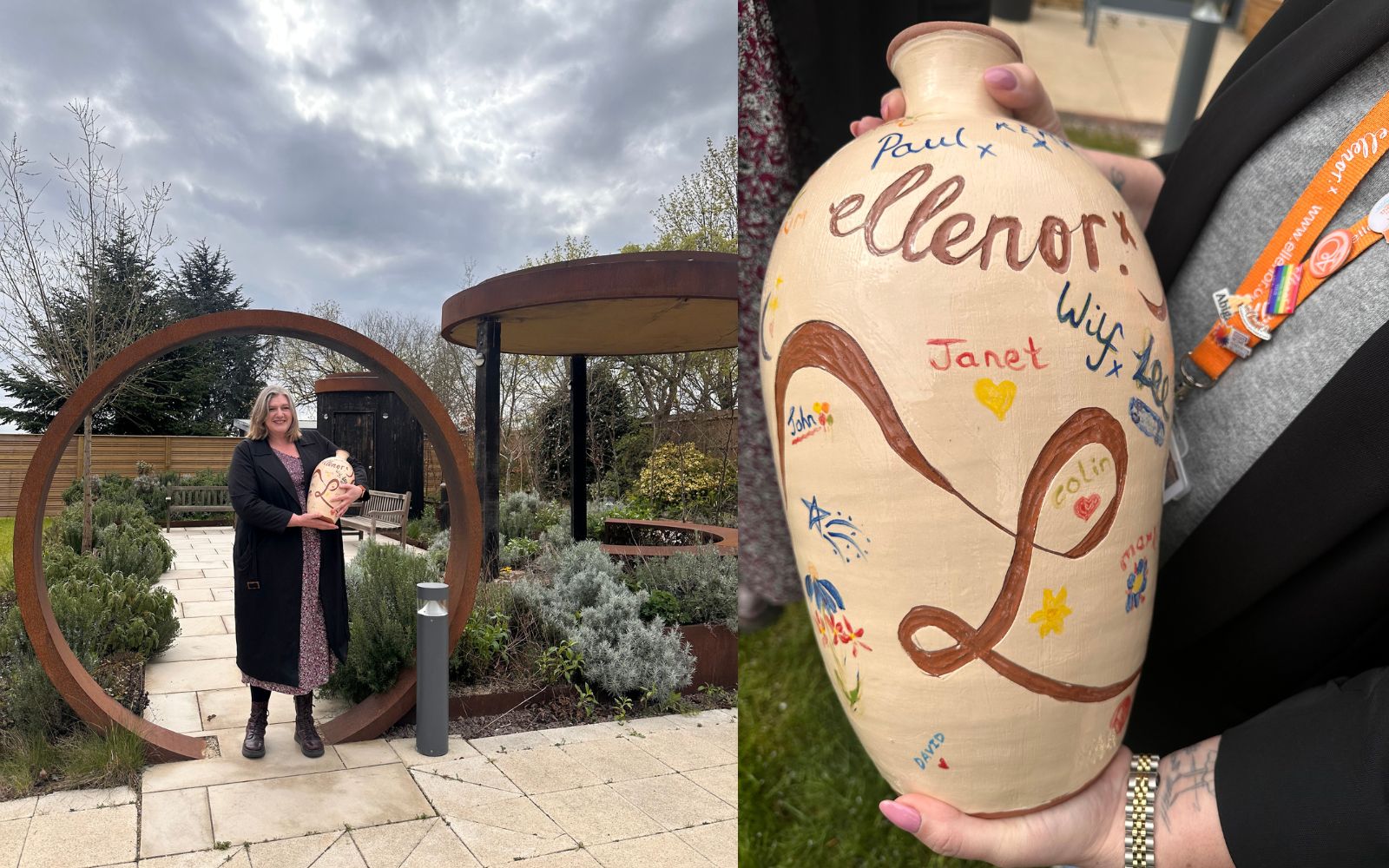
The sessions brought together people from across the community. Some carrying experiences of grief and bereavement, though not all ready to name them. There were different ways to work with clay: small pieces, decorating clay, even a chance to try the potting wheel. People chatting, laughing, getting on with what they were making. And at the centre of it all sat a large ceramic vase Naomi had made beforehand. It’s surface left blank.
“It was just there,” she says. “People could go over when they wanted. No pressure. Just… if it felt right.”
Slowly, it began to change. Names appeared. Patterns. Little flowers, hearts – details that held meaning only to the person who made them.
“I would occasionally look up and see someone sat with it,” Naomi says. “There wasn’t any pressure, it was there if they wanted to.”
Some people added something straight away. Others came back to it later. Some chose not to add anything at all.
By the end, the vase had become something shared. A gathering of memories. A record of people who are no longer here – still loved and not forgotten.
“It was a massive privilege,” she says, to be able to do this, to hold all those names in one place.
The design itself carries its own meaning. A ribbon runs around its form – Naomi’s interpretation of the wraparound care ellenor provides, from diagnosis onwards and for families long after.
For some of those who took part, returning to ellenor, to a place connected to the care of someone they love, was not easy.
One participant, whose husband had died the previous year, described how difficult it had been to return to ellenor.
“I wouldn’t come up here at first,” she said. “But now… I can. I can sit here.”
What she found felt different.
“This feels softer,” she said. “It’s something you’ve made. Something you’ve been part of.”
Naomi sees this all the time.
“You’re using your hands, all those little sensors in your fingertips,” Naomi says. “You don’t even realise it, but it’s calming you, grounding you. You just sort of… drop into it.”
The finished vase will remain with ellenor hospice charity in Gravesend. A place people can return to, not as something cold, but something living, shaped by many hands.
The workshop raised around £2,500. But it was about much more than that.
“The Wonky Potter wouldn’t exist without the students. They are The Wonky Potter. They support me in countless ways, from attending classes to giving their time at community events, especially the ellenor fundraiser.”
“It’s about connection,” Naomi says. “That’s the most important thing.”
Now, as The Wonky Potter continues to grow with a second studio opening soon, she’s thinking about what comes next. How to bring together clay and mindfulness more intentionally. How to create more spaces like this.
“I’d love to offer something ongoing,” she says. “Something that really supports people.”
Because in many ways, everything she’s doing now traces back to that first small pot – the one that wasn’t perfect but was enough.
More than enough, in fact, it changed her life.